2026-11-09 · ~12 min
Seven Hundred Commits to Teach a Reviewer It Was Wrong
In August I wrote one Claude skill to review pull requests in my voice. Three months later it runs on a schedule, borrows Codex when Claude runs dry, builds on teammates' reviews, and most of its commits are the reviewer being corrected.
My PR review kit is a set of Claude skills that reviews my team's pull requests at Career Team the way I would, in the tone I would, and posts under my account. It reads the ticket before the diff, it never approves anything, and it keeps a log of every time it was wrong. That last part is most of the story.
On Aug 14 I committed the first version of a skill called /check-pr-voice. The next day I made forty more commits to it, and one of them was titled feat(check-pr): review the ticket, not just the diff. That should have told me how this was going to go. As a snapshot, on Nov 9 the repository has 737 commits and sits at release 2.6. The number sounds like a flex and it is closer to a confession: most of those commits are the reviewer being told it was wrong, and me building the machinery to tell it.
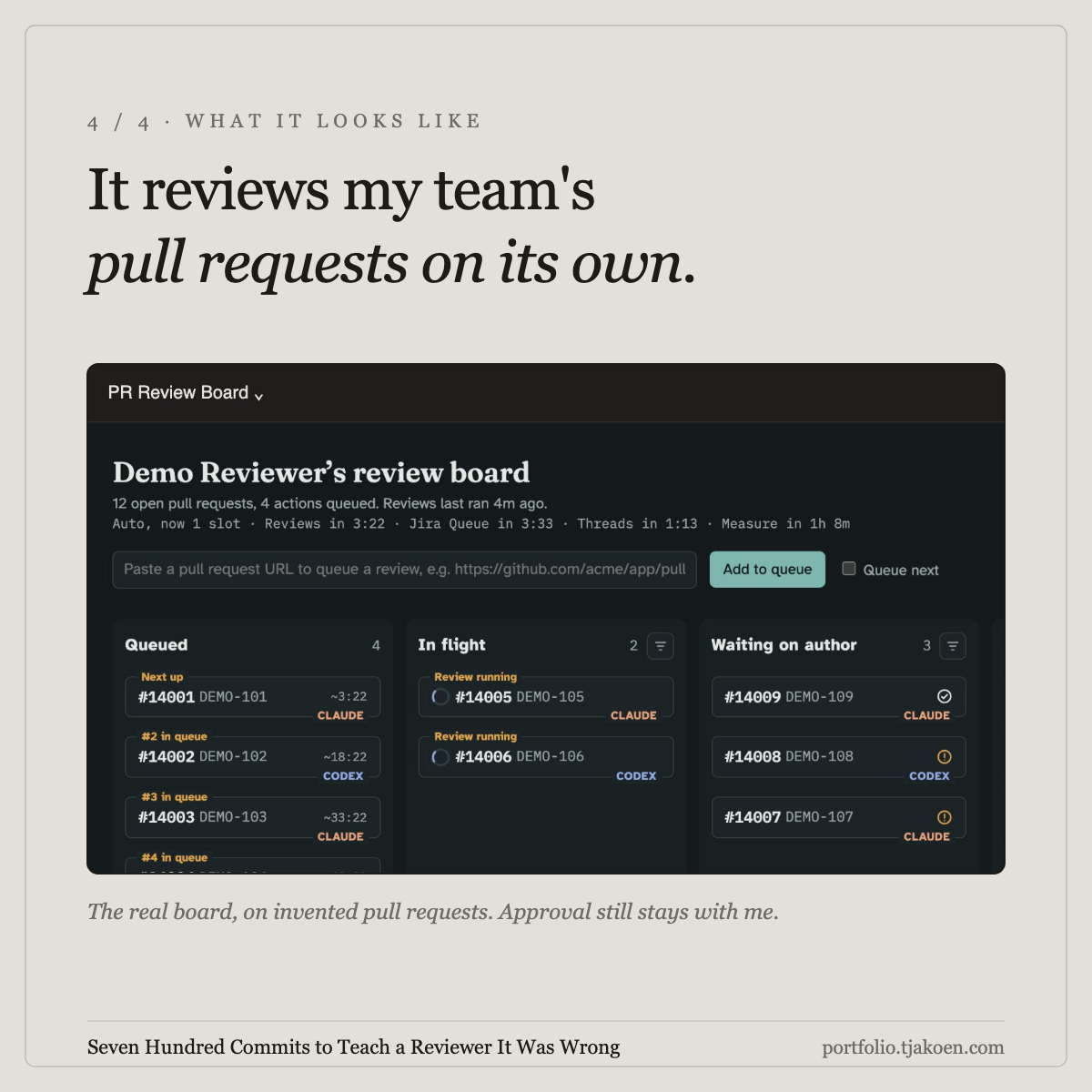
Every screen in this note runs on mock data. The board is the real one, running on invented pull requests and invented people. The real version holds Career Team's work, and it stays at work. I am careful about that line, so this note shows how the kit works and how it got there, never what it found.
The turns, on one line
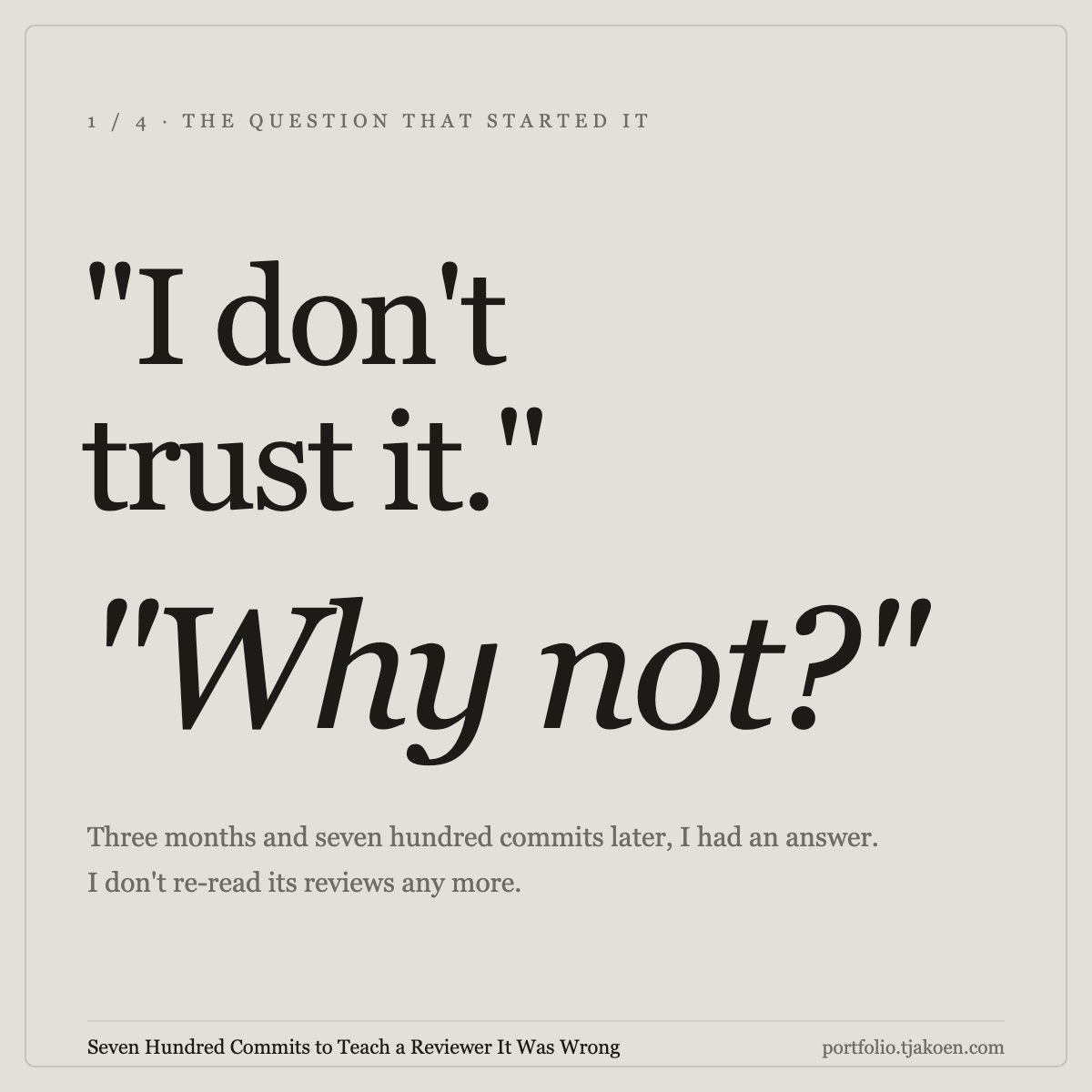
Why not?
Before any of this I was already using the company's standard PR reviewer, and I was still reading every word it wrote. My name goes on the approval, so its output had to be right before I clicked anything. I also sit in the architecture group, which means some pull requests cannot merge until I review them, and that summer, code review was a real bottleneck on the team. Architecture review was the worst of it, and a fair share of that queue was waiting on me.
So in a manager meeting I raised it with Kaither Holiway, our Director of Engineering. Before Career Team he was a Senior Software Engineering Manager at GoFundMe, where by his account the engineering teams went hard on AI and built it into how they actually worked, and that was the bar he wanted to bring here. I explained that I was still checking everything the reviewer did by hand. He asked why. I said I did not trust it.
He asked, "Why not?"
Something clicked. I did not have a good answer, and I realized the honest response was not to keep distrusting the reviewer but to make it into something I could trust. Then came the rabbit hole.
The first thing I noticed was how much there was to learn from other people's reviews. The architecture group takes review seriously and leaves a lot of feedback, so before I changed a line of the reviewer I pulled hundreds of their reviews and mined them for the rules they kept repeating. That turned into the self-learning loop the rest of this note is about: the reviewer's own comments scored against what happened next, and every miss folded back in as a lesson.
From there it spread outward, and it turned into a habit. Whenever someone shares something I think could make the reviewer better, a teammate's tool, a post, a paper, I take what I can from it and put it in the kit. I read how other reviewers work and kept reading as new things came out. When I saw how Google writes down its standard for code review, how Alibaba moved the parts of its AI reviewer that must not go wrong out of the model and into plain code, and how Addy Osmani describes the loop that agentic work runs on, each one went into the kit. The full list is in the sources at the end.
What Kaither gave me in that meeting was a question. It made me want to trust my AI, and trust it for reasons I could show rather than a feeling. Everything below is me trying to earn that: a record I could check, a fix every time the record said it was wrong, and guardrails around the parts I was never going to hand over.
It started as a reviewer I had to babysit
The first version was a skill I typed a pull request number into and watched. I started from the staff-level PR reviewer Kaither built for Career Team's platform group. The core was his: a handful of parallel lenses over the change (security, accessibility, tests, migrations, a staff-engineer read), every finding checked a second time before it was kept, and one review posted with comments anchored to lines. What I added was the reading before the diff, the linked ticket and its epic, and my own tone on the way out. Then it waited for me to run it again. Theirs is the reviewer for everyone. Mine is the opinionated one, and it reviews the way I do.
The first two days of history are mostly the skill learning manners. The commit titles read like notes from a bad first week:
$ git log --reverse --format='%ad  %s' --date=short
2026-08-15  feat(check-pr): review the ticket, not just the diff
2026-08-15  feat(check-pr): post one review, and stop calling everything Minor
2026-08-15  feat(check-pr): ask whether we already built this
2026-08-15  feat(check-pr): scale the review to the diff, but never by size alone
...
Each of those is a review I watched go out and winced at. It was useful from day one and annoying from day one, which I suspect is true of most first hires.
Then it had to keep score
On Aug 18 the history gets fix(check-pr): the first scored outcomes, and the one lesson in them, and it is the turn the rest of the story hangs on.
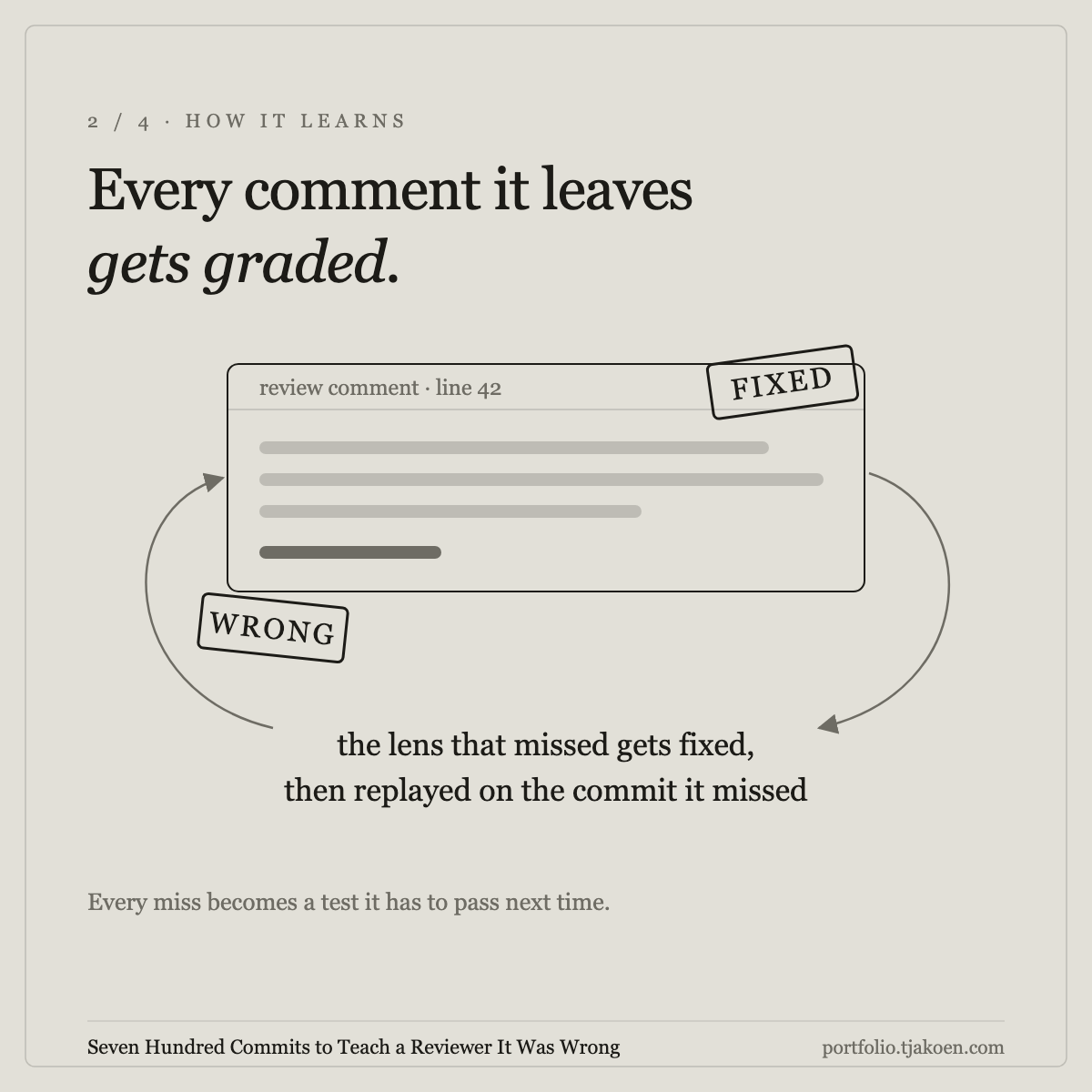
Every finding the reviewer posts gets a row in an outcome log, scored later by what happened to it: fixed, answered, closed without a change, or ignored. Anything a human reviewer caught that mine did not goes into a separate miss log. By Sep 9 there was a standing skill, /calibrate-pr-voice, whose only job is to read those logs and fold the lessons back into the lenses.
I would love to say this went smoothly. On Oct 1 there is calibrate: lock the outcome log, because eleven scores in twelve were being lost. Two routines had been writing to the same file and quietly overwriting each other, so for a stretch the reviewer was being graded on a sample of almost nothing and I had not noticed. A measuring tool that loses its measurements is a very confident way to learn nothing.
A reviewer does not get better by being prompted harder. It gets better by being shown, row by row, where it was wrong.
This is the part of the kit I care about most, and the part I would build first if I started again. The reviewer is not a prompt I keep polishing. It is a loop that grades itself and changes itself, and I sit at one point in it. This is the loop from the talk:
Two details in that loop do most of the work. Every score is read per topic, never as one average, because a reviewer can be excellent on database changes and noisy on frontend speed, and the mean of those looks fine. And the heavy bar on the arrow into a change is me. The loop can find the lens that needs fixing and propose the fix, but it cannot change itself without my sign-off, and every change it does make is re-run on old pull requests before it counts.
The talk was the old version
On Sep 17 I introduced the kit to the team in a talk, Every Time It Was Wrong. By then it was not a reviewer I ran by hand any more. It was already largely automatic and already learning from itself. It ran out of the Claude Code desktop app: scheduled checks found pull requests waiting for review, spun up a session for each one, and filed every session into a sidebar section by its status, so the sidebar itself was the board. The same day I moved the board off the tool I had started it in and onto that sidebar for good.
The deck is still up, and its diagrams are the clearest picture of how the reviewer thinks, so two of them are in this note. This is the review as the talk showed it. Six specialist reviewers read the change at once, and most of what they find never reaches the author:
That shape has not changed since.
The same days in the history are the densest of the early stretch. A second skill, /respond-pr-voice, started answering replies waiting on us, checking a claimed fix at the new commit, resolving its own threads and updating the verdict label. A push from the author started queueing a re-review, an incremental pass over the new commits, instead of a whole new review. Every unattended routine got one report format, so I could read a night's work in a table instead of a transcript.
Then other people wanted it
On Sep 24 the repository was restructured so someone who was not me could clone it, and on Sep 28 the installer learned to set the kit up from a profile per person. Everything personal, the outcome log, the watcher state, the boards a person cares about, moved under that person's own directory.
The board page followed on Oct 14 and 15: one page per person with Board, History, Calibration and Stats tabs, cards that move between columns depending on who owes the next move, a Run now button, settings that live on the board, and setup from one paste. The 1.0 release notes put it plainly: the first release a teammate can set up, use and repair alone. I am no longer the only manager whose reviews run through it.
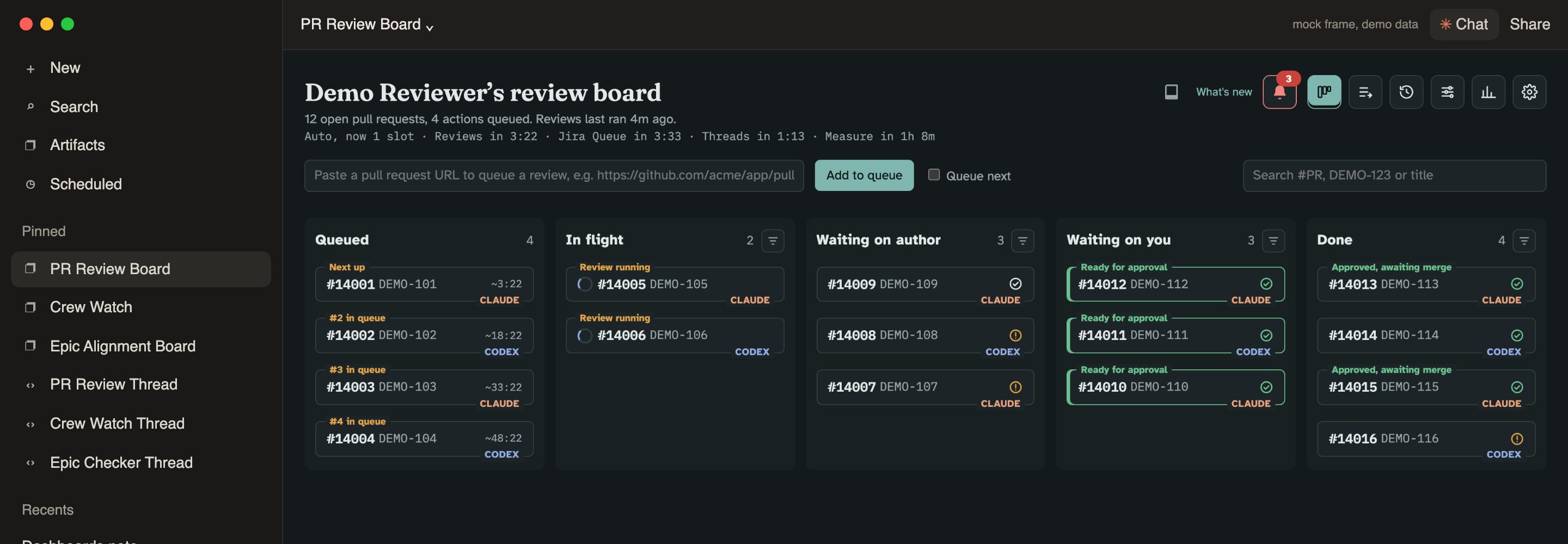
Once there were two kits, they started reviewing the same pull requests. On Oct 19 the kit learned the second look: when a teammate's kit has already reviewed the head commit, mine runs only what theirs left unchecked, posts an addendum. At first it left a one-line note when it had nothing new; now it posts nothing at all. Since Nov 4 every second look carries its own label, so a silent one still shows on the pull request. In November my kit also started taking a second look when the platform group's reviewer had already left a verdict. It builds on that review instead of repeating it.
Then it needed a second engine
There is a practical problem with running a reviewer on a schedule, which is that my Claude usage is finite and pull requests are not. On Oct 8 the reviewer was installed and adapted for Codex, and by Oct 11 the calibration loop found reviews from both hosts through their attribution labels, so a review Codex wrote is scored in the same log as one Claude wrote.
Then it became the fallback for when I run low on tokens. On Oct 15 the switch stopped being something I flipped by hand, and on Oct 20 and Oct 21 it got finer. As my weekly Claude use climbs, the kit runs fewer reviews at once, and past a threshold I choose it hands them to Codex:
| Weekly Claude use | Claude reviews at once |
|---|---|
| Under 70 percent | Four |
| 70 percent | Three |
| 80 percent | Two |
| 90 percent | One |
| Past my threshold | New reviews go to Codex |
A pull request keeps the engine that first reviewed it, so a conversation that started with Codex finishes with Codex instead of changing voice halfway through.
That still left the week I burn through Claude completely, when the board itself has nothing to run on. So I built a second, much smaller thing next to the kit: a minimal Codex dashboard that shows the review queue and lets me keep reviews moving with no Claude at all. It is plain on purpose. It exists for the bad week, and on the bad week I want a list and a button, not a tour.
Codex is the backup, not a peer I benchmark against in this note. The comparison work exists in the plans folder and it is not finished. What is finished is that a quiet week on one engine no longer means a quiet week on reviews.
Then it had to earn its keep
A reviewer that runs every night has a bill, and I wanted model choices made the same way as lens changes: on results, not on taste. So the model behind each part of the kit is a decision with a trial behind it.
| What runs it | What I tried | What the results said |
|---|---|---|
| The six lenses and the skeptic | Pinned to Sonnet in September | They held their precision, so the expensive model only does the parts that need judgment |
| The review itself | Opus 5 at medium, then Opus 5.5 at medium, and now Opus 5.5 at low | Low held up: across thirty reviews it found more per review than the medium baseline, and not one blocking finding was thrown out |
| The routines that only check for work | Haiku | Far cheaper per check, but a pinned model does not switch a session that is already running, so the slots went back to Opus |
On Oct 13 the kit started pricing every review session, lens agents included, at list rates for the model each turn ran on. That is an estimate rather than the bill, but it is the same estimate every week, so the trend is real. The board's Stats tab plots it, and over the four weeks the first data covered, the median cost of a review fell by more than half. Trial four, a stricter low setting, is still running.
Then it had to prove its repairs held
A replay ledger arrived on Oct 14, and by mid-October it did the part that convinced me: when a lens gets repaired after a miss, the repair is replayed on the pull request the miss came from, at the commit the original review ran on. On Nov 3 a batch of thirty-three replays came back and nine lens rules were fixed because the replays found them wanting. A repair that has not been replayed is a hope. A replayed one is a receipt.
Then it got a map of the code
The lenses I started from read the diff and the files around it. That is the company reviewer's shape, and it misses the thing that breaks most often in a codebase our size: the code that is not in the diff but depends on it. So on Oct 18 the kit gained code graphs, built with Graphify from each branch the team ships, and shared by everyone who runs the kit.
Before the lenses run, the review cuts a slice of that graph for the change and hands it over:
- who calls each changed function,
- functions with the same name in other apps,
- the permission and feature gates on each one,
- and the tests that touch them.
The graph is rebuilt whenever its branch moves. It also does a second job I did not plan for. Risk intake asks the same graph whether an outside pull request reaches code my team owns, and uses it to ignore the shared helpers that almost everything touches, which would otherwise make every change look like ours.
This is company code, so Graphify gets the same treatment as everything else in the kit that touches it: hard blocks, not good intentions. It is an outside library, and the kit runs only its code-reading pass, as a pinned version checked against a hash, in a sandbox with no network. Its installers, hooks and server are never run. The graphs it produces stay in the kit's private repository and on the machines of the people who run the kit. A tool that reads the whole codebase cannot send any of it anywhere, because nothing in that sandbox can reach anywhere to send it.
The honest limit: the graph slice is still on a watch rather than on for everyone. It runs on my reviews while I measure whether the lenses that get it find more than the ones that do not.
Then it had to decide what deserved a look
The newest turns are the reviewer getting choosier about its inputs. On Oct 26 it started reading the epic's decided rules and the decisions made in Jira comments, and on Nov 3 it folded in the epic check that Kercwin, a tech lead on my team, built as his own plugin after seeing my board (the story is in I Showed My Team a Dashboard), so a deviation the team already agreed to stops being flagged as a defect. The same day risk intake arrived: a pull request from outside my boards gets queued only when it touches a high-risk area and reaches code my team owns, capped at a ranked three a day so the queue does not drown.
Release 2.6, on Nov 4, made every lens prove it read its rules before its findings count. A lens that skips them twice gets named in the evidence block, and the review cannot post PASS. Show your work, or it does not count.
Then it let one through
I have run the kit unattended for months, and in that time we broke production once on a change it had passed. A data-fix migration was meant to remove a few unwanted entries from one customer's dropdown. Its filter matched on a type field that some unrelated rows also carried, so it switched off a handful of reference rows another part of the product depended on. The rows were switched off, not deleted, so nothing was lost, and they were restored from the backup the migration itself had taken. But for a few weeks some staff could not record work they needed to record, and nothing on screen told them why.
The reviewer had read that migration and said nothing. So it went through the same loop as every other miss, with more at stake. It was recorded against the migrations lens, and on Oct 30 that lens got a new rule: a change to rows that other features read is checked against every reader of that data, not just against the ticket that asked for it. Then the repair was replayed on the original pull request, at the commit the review had read the first time, with no hint of what had gone wrong. It blocked the change. Two other pull requests with the same shape went in as test cases alongside it, and it caught those too.
One production break in months is a record I am comfortable defending. It is also the best argument for the loop I have. A reviewer that never misses does not exist, so the question was always what happens after the miss.
How it works now
A pull request lands on my board from my team's code review column, from risk intake, or because I pasted it in. Scheduled routines take it from there, and only between 17:00 and 06:59. That is my working day, since I work nights, so every review lands while I am awake to answer for it.
The loop at the center is the one I showed in September. Reviewing, following up and learning from every outcome were all running by the talk. What changed since is everything around that loop: where pull requests come from, what a review reads before the diff, who else is reviewing, and which engine does the work. The dates below say which is which.
The review. A Reviews routine works through the same steps every time:
- It reads the ticket and its epic before the diff. Since
Aug 15. - It sends six specialist lenses over the diff and tries to refute every finding before keeping it, then posts line-anchored comments with a PASS, REQUEST CHANGES or BLOCKING verdict. Since the first version, and on the September slides.
- It checks the change against the epic's decided rules and the decisions in the ticket's comments, and notes any other open pull request editing the same lines. Since
Oct 26. - It runs the epic check where the epic has one. Since
Nov 3.
After the review. Each event that follows gets its own response:
| When this happens | The kit does this | Since |
|---|---|---|
| An author replies to a thread | Answers it if the team's recorded decisions settle it, otherwise leaves it for me | Sep 16 |
| An author says it is fixed | Checks the fix at the new commit and resolves its own thread | Sep 16 |
| An author pushes new commits | Runs a re-review over just those commits | Sep 17 |
| A teammate's kit already reviewed the head | Runs a second look over only what theirs left unchecked | Oct 19 |
| My Claude use passes the weekly threshold | Hands new reviews to Codex | Oct 15 |
The learning half. This is the part that earns the trust, and most of it predates the talk:
- Every comment is scored by what happened next. Since
Aug 18. - Every miss is recorded with the lens that should have caught it. Since
Aug 19. - A theme that keeps being closed without a fix gets its lens tightened. Since
Sep 9. - Every repair is replayed on the pull request where the miss happened, at the commit the review ran on. Since mid-October, and the one big addition to the loop after the talk.
The Calibration tab shows each change to the reviewer and why it was made.
It never approves, never merges and never pushes code. Guards block a push rather than merely discourage one. A PASS from the kit means it has nothing left to say, and the approve button stays mine.
What the team felt, and what I got back
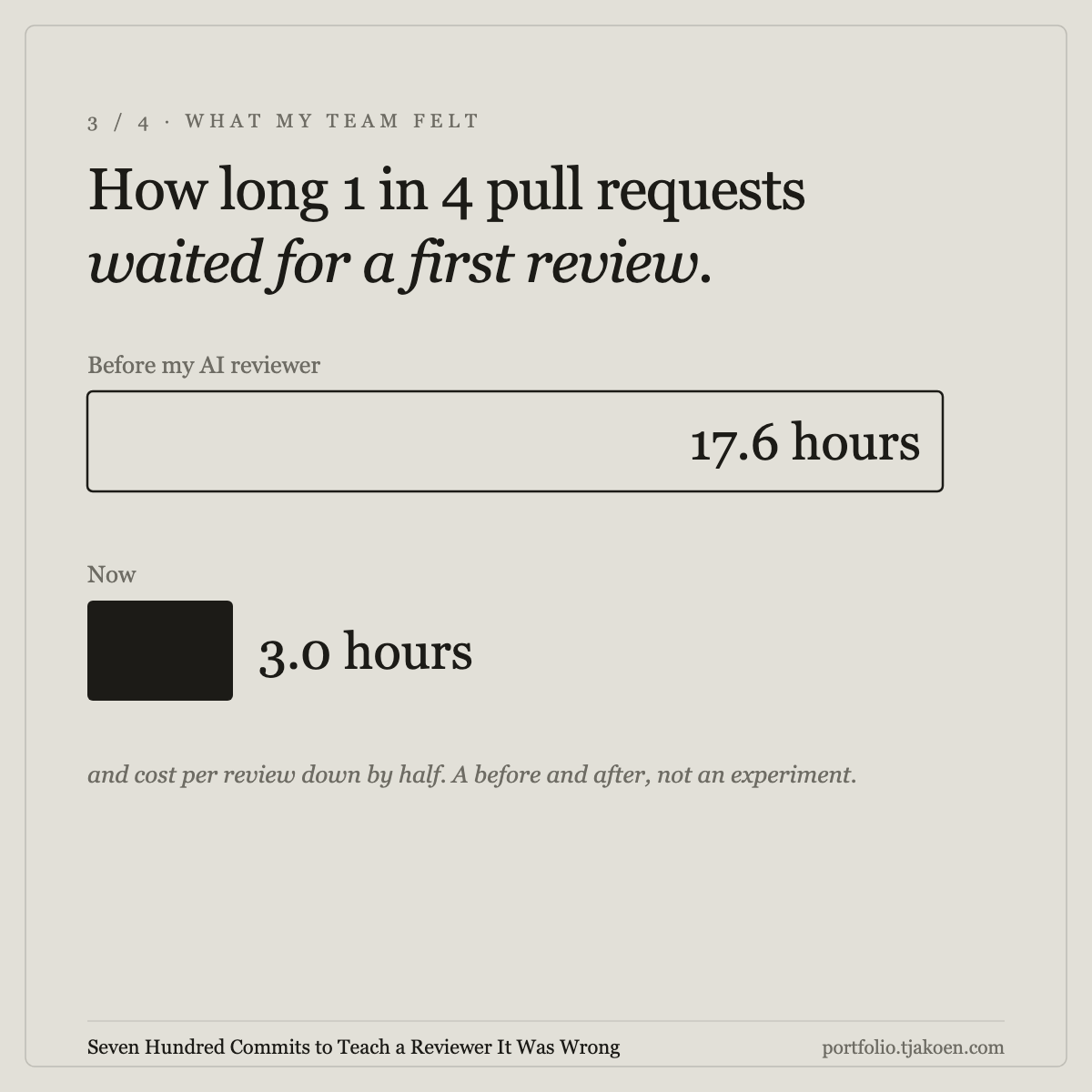
The bottleneck that started all this was review wait, so that is the number I checked. Crew Watch, the team dashboard I built for my one-on-ones and wrote about in I Showed My Team a Dashboard, keeps every pull request my team opened since late July with its reviews. This is the time from a pull request being opened to its first review by anyone other than its author, as a snapshot on Nov 10:
| Pull requests opened | Reviewed | Median wait | 1 in 4 waited longer than |
|---|---|---|---|
Before Aug 14, no kit | 53 | 1.7 hours | 17.6 hours |
Aug 14 to Sep 16, run by hand then on routines | 87 | 1.5 hours | 12.6 hours |
Sep 17 to Oct 14, automatic on the sidebar | 81 | 1.7 hours | 13.2 hours |
Oct 15 to Nov 10, the board and Codex as backup | 98 | 0.9 hours | 3.0 hours |
The median barely moved, because most pull requests were never the problem: someone usually picked them up within a couple of hours. The long tail is what the kit took apart. One pull request in four used to wait most of a day or more. Since the board and the Codex fallback, that one in four waits three hours or more. That is the bottleneck I raised in that manager meeting.
The honest limits on that table: these are wall-clock hours, nights included, so an overnight routine flatters itself against a human who reviews in the morning. The window before the kit is only a few weeks, and other things changed over the same months that I cannot separate from the kit. It is a before and after, not an experiment.
The other half of the payoff was mine. Before the kit, first-pass review ate a big share of my working hours. I was the bottleneck, reading every word a reviewer I did not trust had written. Now I do not re-read its reviews at all. I trust them, which was the whole point of answering Kaither's question, and the calibration that earned that trust runs without me. So the hours that used to go to the review queue go to the people on my team instead: the one-on-ones, the unblocking, the dashboards I wrote about in I Showed My Team a Dashboard. For a manager, that is the real trade. The kit took the part of the job a machine can be held to a standard on, and gave back the part only I can do.
What I have not shown
I have not shown that the kit makes the codebase better. I have shown that its findings get scored, that its misses get replayed, and that the share of its comments people act on is something I can look at instead of guess at. Whether that adds up to fewer bugs reaching production is a longer study than three months, and I have not run it.
Back to that commit on day two, feat(check-pr): review the ticket, not just the diff. Seven hundred commits later the kit still does that first, and almost everything after it is the same idea, applied to the reviewer itself: read what it was supposed to do, then check what it actually did.
Sources
Almost nothing in the kit was designed from scratch. Most of it was extracted, and the kit keeps its own credits file so every rule can be traced. The parts that shaped the system, as opposed to a single rule:
Inside Career Team
- My colleagues' review comments. The kit's standards are mined from real reviews on our codebase, and a rule earns its place when the team's own reviewers said the same thing more than once. The times a person caught what the reviewer missed are worth the most, since each one became a gate, a standard or a test case.
- The platform group's Claude plugins: Kaither's staff-level PR reviewer, whose lenses and verification step the kit started from, and the PR fixer whose evaluation suite taught me to test whether a review is any good, not only whether the machinery runs.
- Kercwin's epic check, which supplies the epic decisions and the collision check, and which the kit runs as a plugin since
Nov 3. How he came to build it is in I Showed My Team a Dashboard.
Published work
- Addy Osmani, Loop Engineering, for the shape of the loop, and his writing on code review becoming the bottleneck once code arrives fast.
- Google's The Standard of Code Review, for continuous improvement over perfection, and for polish as an ignorable nit.
- Sadowski and colleagues, Modern Code Review: A Case Study at Google, and Bacchelli and Bird, Expectations, Outcomes, and Challenges of Modern Code Review. Both also mark the one place the kit disagrees with the literature on purpose: it cuts most of the code-improvement comments those papers say human review earns its value on, and trades them for precision.
- The Cisco and SmartBear review study, for the evidence that coverage falls as a change grows. Its numbers measure human fatigue, so the kit borrows the shape and not the threshold.
- alibaba/open-code-review, for moving every step that must not go wrong out of the model and into plain engineering.
- Conventional Comments, for every comment label the kit posts and the rule that a reader should never have to guess whether feedback blocks the merge.
- Anthropic's model migration guidance, the premise of the kit's effort trials.
- Graphify, which builds the code graphs the lenses read and risk intake uses to tell which code is my team's.
My own notes
- The Check Ran Once in 165 Sessions, for distrusting a check that reports success while looking at nothing.
- Watch Its Hands, for verifying what an agent did rather than what it says.
- I Was Shipping Faster Than I Could Understand It, for one loop per repo.
- VOICE, the writing standard every posted comment is held to.
The judgment is human. The typing, by design, is not.