I Built a Command Center and Then Forgot to Turn It On
PANTRY was supposed to be where my AI sessions and I agreed on what to do next. For two months it sat in a folder, waiting for me to start it by hand. This is how it became an app that sits beside the work instead.
I have to be honest about PANTRY. I built it, I wrote about it, and I barely used it. Most days it just felt like it was in the way.
It was not broken. It was one more thing between me and the work. It lived in a sibling folder, it came up with a command I had to remember, and it served one project on one port until I closed the terminal. Every session I opened with Claude went straight to the code, because the code was right there, and the board that was supposed to tell that session what to do sat in a folder I had not opened in days.
And yet I never stopped working on it. I kept improving it and kept it wired into the loop: the doctor at every session start, the plans folder every repo writes to, the standards it mounts. I could not bring myself to use the board, and I could not bring myself to let it go either, because I could not argue with the goal. Projects that stay aligned and accountable, and agents in the loop that cost me nothing extra to keep there, are worth a tool I find annoying. That is a strange relationship to have with your own software, and I suspect it is not a rare one.
As a snapshot, on Nov 14 the PANTRY repository holds 176 commits on main. Here is where they fell.
Commits per month on PANTRY's main branch. November counts only its first fourteen days.
That gap is the story. I want to be fair to it before I tell it, because a quiet repository has more than one explanation. September and October were also the months my PR review kit ate every evening I had. But the review kit is the tell. It ran on a schedule, so it got used whether I remembered it or not. PANTRY waited to be asked, and nobody asked.
It started as a cockpit
The first commit is a plan, and the plan was big:
$ git log --reverse --format='%ad  %s' --date=short
2026-07-08  docs(pantry): plan the dev-docs + AI cockpit app; PROOF becomes a mountable layer
2026-07-08  feat(pantry): the dev-docs + AI cockpit app (v1) — composes the layers
2026-07-08  feat(proof): piece 3 — live board over SSE (file watcher + broadcast)
The idea was simple and I still believe it. I work across half a dozen repositories with Claude and Codex doing most of the typing, and lately DeepSeek too, and none of those sessions remembers the last one. They need somewhere outside their own context to read what is planned, what someone else already took, and what is waiting on me. A plans folder in each repo gets you most of the way, and the loop setup still says so. PANTRY was the layer on top: one board over those plan files, a live view of who is working on what, and the standards mounted where a session could find them.
It composed the rest of the stack, so it also ate the rest of July in plumbing. Forty-nine commits, a good share of them about where packages resolve from. I am a design-systems person to my core, and I spent the first month of a command center on its supply chain.
Then it got a doctor
2026-07-26  feat: pantry doctor — the loop's mechanical tier
2026-08-11  feat(doctor): four checks for work that is finished and still sitting
2026-08-17  feat(doctor): the cold start gets measured instead of remembered
The doctor is the part of PANTRY that never needed me to open anything. It runs from a hook at the start of every session and prints the rows you can see at the top of my own transcripts: worktrees against live sessions, run reports falling behind, a graph older than its code. August was its best month. Seventy-eight commits, most of them a new check for a way I had been caught out.
That should have been the hint. The piece of PANTRY that fired by itself kept growing. The piece that waited for a browser tab did not. I wrote about the sharpest version of that lesson in The Check Ran Once in 165 Sessions, and then, I am a little embarrassed to say, failed to apply it to the board.
It could serve a project, one at a time
2026-08-10 feat: let PANTRY serve a project under its own originThis is the commit that made PANTRY a real web app, and the one that set up the problem. Each project got its own server. To see the board for this site I had to go to the pantry folder, start it pointed at this repo, and keep that terminal alive. A second project meant a second server on a second port. The address changed depending on which I had started first.
None of that is hard. It is just a step, and a step that sits outside the work is a step that does not happen. I would open a session meaning to start PANTRY first, the session would already be reading code, and by the time I thought of the board the plan was in my head and the chat instead.
Nine commits
2026-09-03  feat(control): the page that says where the project is
2026-09-15  feat(doctor): measure worktree isolation against live sessions
2026-10-02  feat(timeline): show run close activity
The board still got the occasional page. The doctor still got checks, since the doctor was the bit I actually saw. But the commit count tells you how often I opened the thing, and it was close to never.
Then it stopped waiting to be started
2026-11-04  🐳 Add the always-on hub that serves every project from one container
2026-11-04  🔌 Serve PANTRY to Claude Code and Codex over MCP from the hub
2026-11-04  🎛️ Let agents claim ready plans from PANTRY over MCP
2026-11-04  🧭 Make the alignment brief PANTRY's home page
One day, eighteen commits, and it is the day PANTRY started working. The hub was one Docker container that served every project at once, so there is nothing to start and no port to remember. And the agents stopped needing me to open the board, because the board came to them. A session now calls PANTRY over MCP before it does anything: it reads an orientation brief, asks what is next, claims a plan so no other session takes it, and heartbeats while it works. A claim that goes quiet for thirty minutes expires and the plan goes back on the board. (The container did not last. Ten days later the hub went native, and the container, its image and its Docker files are gone.)
What a session does with PANTRY, over MCP, without me opening anything.
The goal of PANTRY, and it took me four months to say it plainly, is to keep my projects aligned and accountable, and to make working with agents in the loop feel like no extra work at all. It is not a dashboard for me to admire. It is the place where my sessions and I agree on what is being done and by whom, so I can run several at once without two of them rewriting the same file, and so the one thing only I can decide sits in a column called Needs you instead of scrolling past in a chat.
The usage tracking came a week later, and it settled a question I had been answering with feelings:
2026-11-10 Track token usage per project, plan, area and model, with a Usage pageEvery session that writes now works under a plan, so its tokens land on that plan. The rule is enforced by a hook rather than by my memory, which by now you will not be surprised to hear was the point.
Then it moved beside the work
Where the board lived. Each step took one more thing off the list of what I had to remember.
The agents were using PANTRY. I still mostly was not, because looking at it still meant switching to a browser tab. So I asked whether I should drop the web app and move the board into Obsidian.
That question did not come from nowhere. Two people on my team track their work in Obsidian. Kyle, a junior, built himself a work board in it, which I wrote about in Show Them the Board. And I watched a senior engineer on the team run her whole week out of it, one checklist at a time. I have been through the entire to-do app journey, Obsidian included, and none of them stuck. She is a checklist person and it simply works for her. I am honestly envious.
So the answer was no, and not because Obsidian is wrong. It would show the plan files, but it would not know about claims, heartbeats or a session that died halfway through, and it would be one more app I open for a week and then stop opening. What I wanted was not a different tool. I wanted PANTRY to feel like a workspace, the thing that is open next to the work rather than a destination.
That turned into four pieces of work, run as four sessions at once, each with its own plan on the PANTRY board. I used PANTRY to work on PANTRY, which is either the best test a tool can get or a very elaborate way to avoid using it for anything else. Probably both.
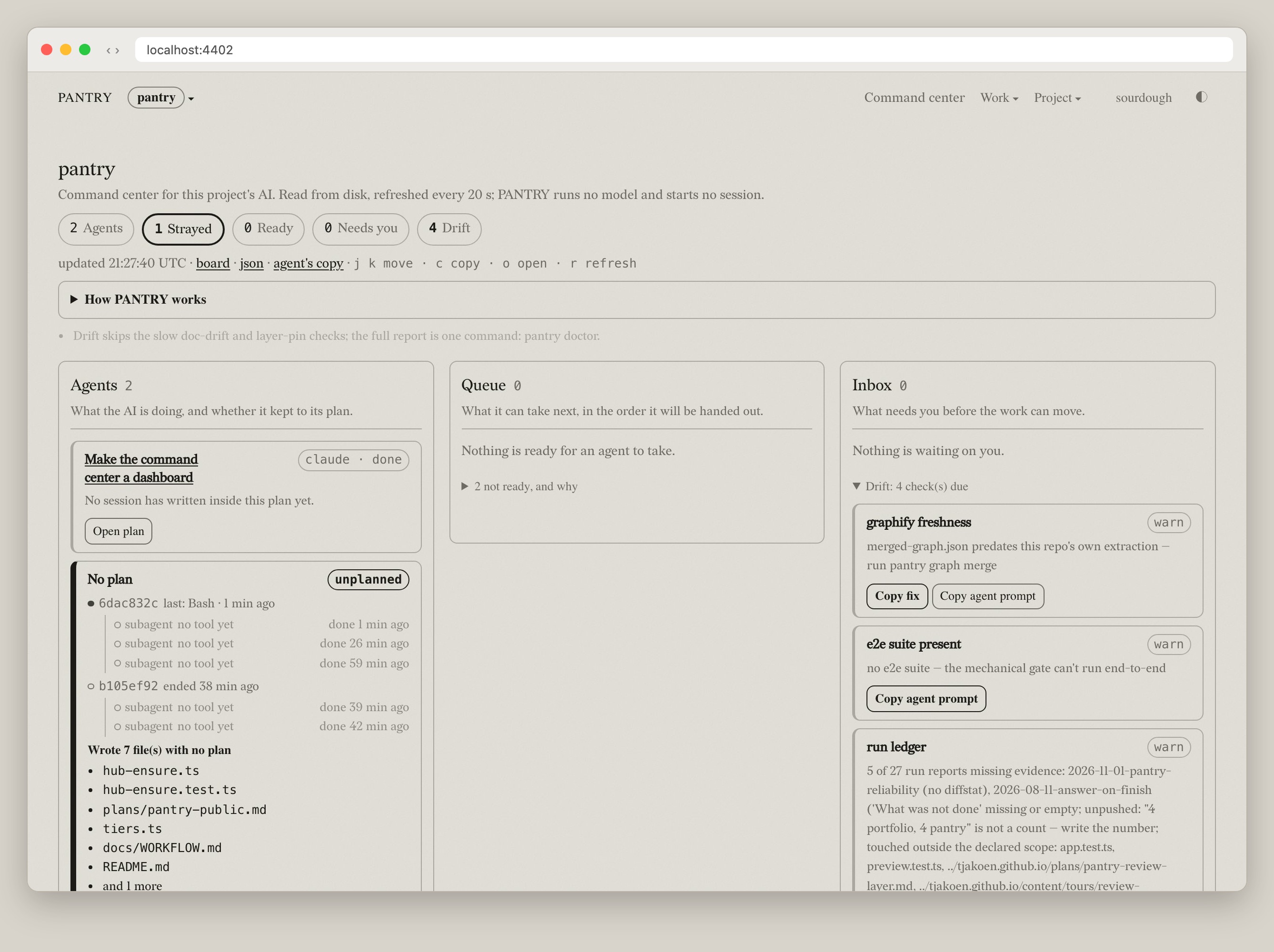
It also caught us. While they ran, the command center had flagged its own builders: seven files written outside any plan, marked Strayed, sitting in the Agents column for anyone to see. The tool whose job is keeping work accountable held the work on itself to account, and I would rather show that than crop it out.
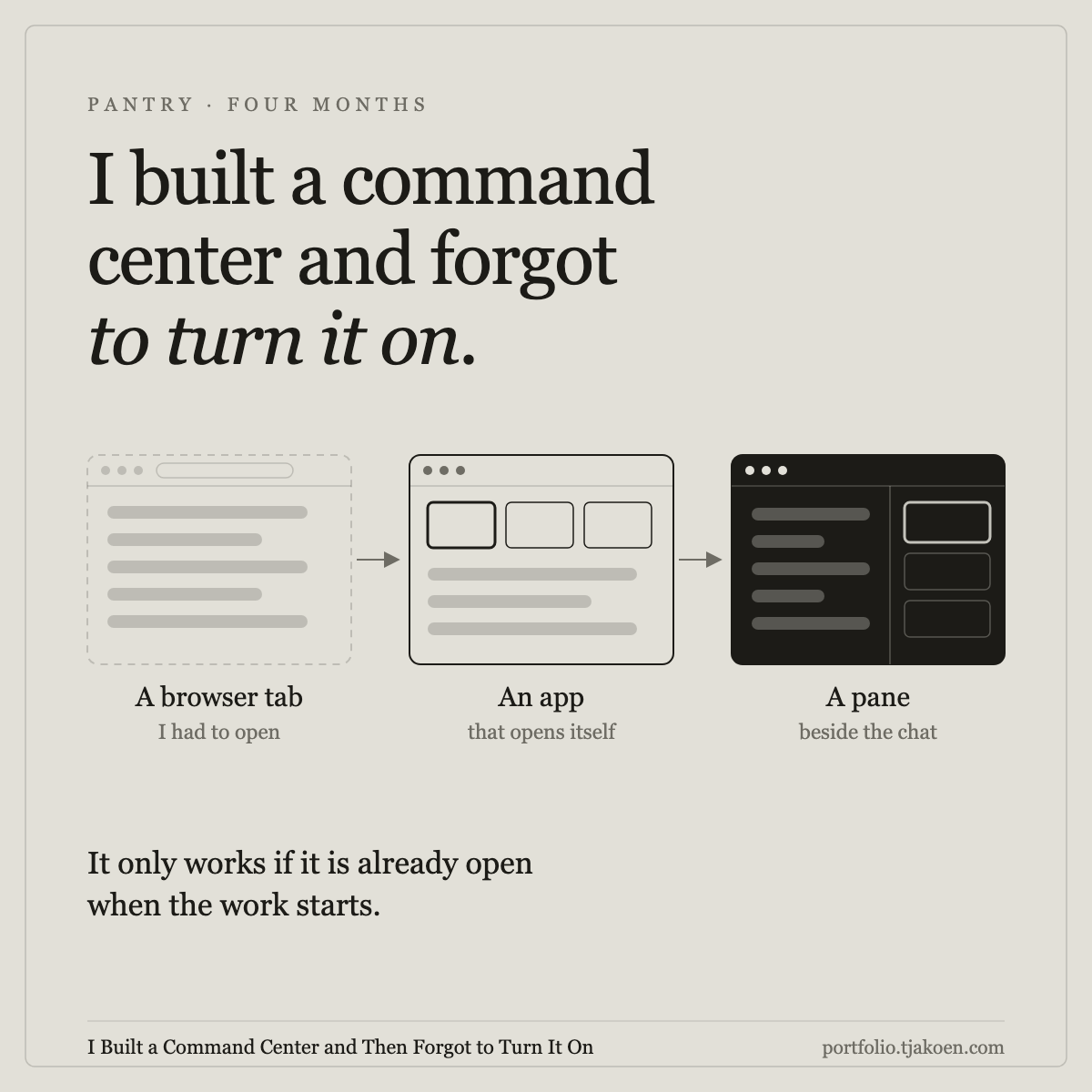
PANTRY only works if it is already open when the work starts. Everything since November is that one sentence.
The dashboard. Needs you moved to the front first. Then the top bar became a sidebar of projects with their worktrees folded underneath, a preview pane, and a narrow sidebar mode built for living in a strip down the edge of the screen. That merged as tjakoen/pantry#4.
2026-11-14  💄 Move PANTRY to a sidebar layout with Needs you first
2026-11-14  📊 Make the command center a dashboard, with a sidebar mode (#4)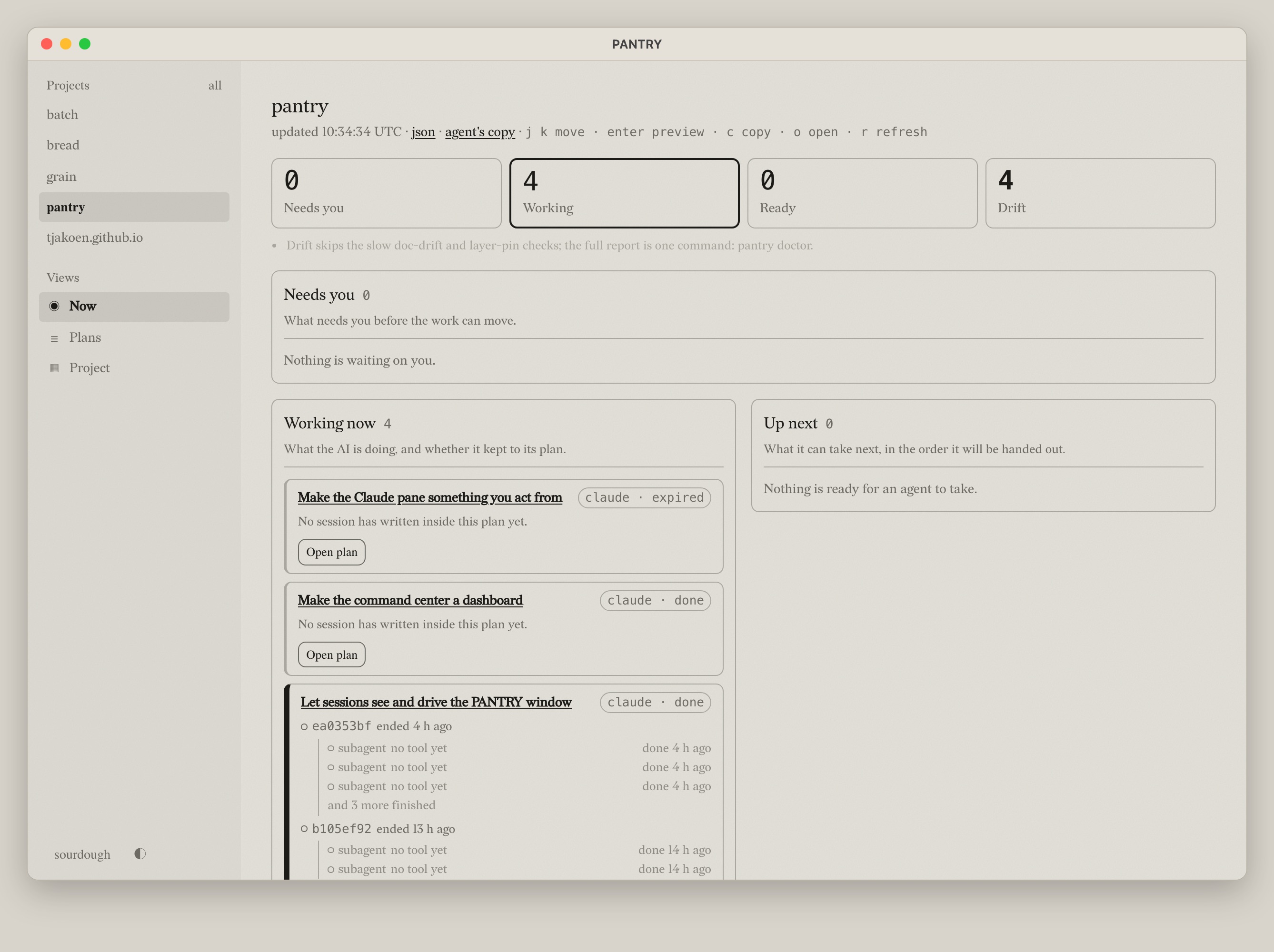
The desktop app. A Tauri app, picked over Electron because it uses the system webview instead of shipping its own browser, so it costs a window rather than a gigabyte. It finds the hub by itself, shows an offline page with a Start button when the hub is down, and keeps the Needs you count in the menu bar. Alongside it, two commands: one that makes sure the hub is running and returns at once if it already is, and one that brings the app forward on a project. My session-start hook now calls both. I tested the cold start by stopping the hub first: the hook brought it back up and opened the app before the session had read a file. The first commit for the shell said, honestly, that it had not been built yet. By the end of the day it was built and installed on my machine.
2026-11-14  ✨ Add pantry hub ensure, a richer health endpoint and pantry open
2026-11-14  Add a Tauri desktop app that finds and starts the PANTRY hub (#7)
2026-11-14  🪟 Bring the PANTRY window forward when a link launches the app
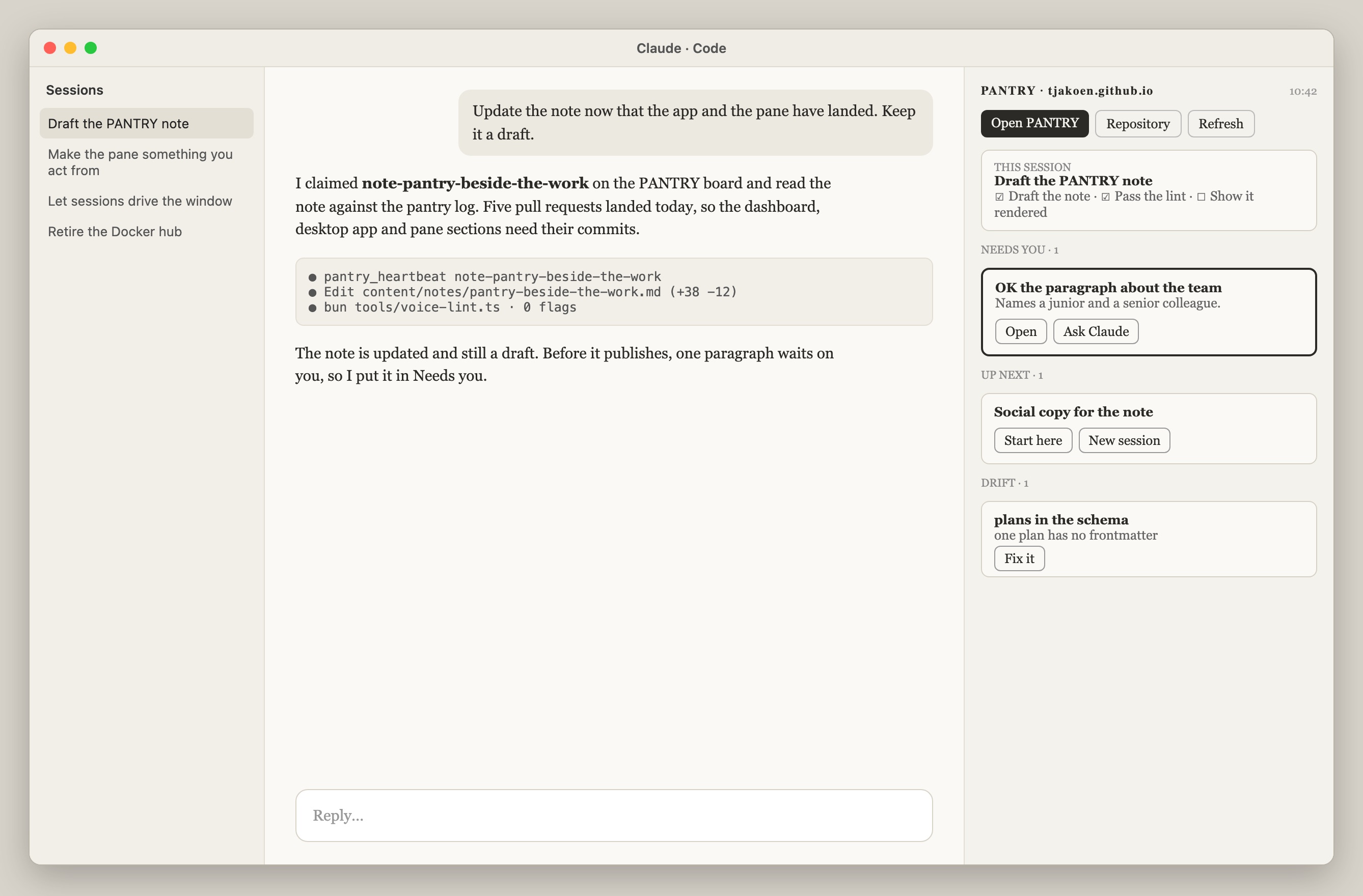
The pane beside the chat. A Claude Code plugin that shows PANTRY in a pane next to the conversation: the project's Needs you items, the work in flight, and a link into the sidebar mode. The count also sits in the status line. This is the piece I wanted most, because it puts the board in the one window I never close. Merged as tjakoen/pantry#6.
2026-11-14  🧩 Add a Claude Code plugin that shows PANTRY beside the chat (#6)
2026-11-14  💄 Make the Claude pane something you act from
The second commit turned the pane from a readout into a place to act. It leads with the plan the current session holds, puts Open PANTRY and Refresh at the top, gives anything waiting on me Open and Ask Claude buttons, and lets a ready plan start in this session, a new one or a child agent. Each drift check gets a Fix it button.
The public release. PANTRY was written for exactly one person, and a release has to admit that. The doctor's checks now come in three tiers. The contract can fail: plans in the right shape, the MCP server registered. The loop warns with a fix and a link. My own habits, the run reports and the standards I care about, stay silent unless a project opts in. Someone else should be able to use PANTRY without inheriting my opinions about commit messages. Merged as tjakoen/pantry#5.
2026-11-14 🚀 Prepare PANTRY for a public release, with tiered doctor checks (#5)The window a session can drive. This one was not on the list in the morning. Once the app existed, it seemed silly that a session could only tell me about a plan. So PANTRY got the same shape GRAIN gives a page: a session asks what it can see, gets back the views and plans with the moves each one allows, and then makes a move. Ask for a move that does not exist and it is refused, with the valid ones listed. I tried it the same day. A session asked to show me the plans view, the window went there, and a second look confirmed it. The try also found a bug: on a project that proxies a preview, as this site does, the first look failed until a fix landed.
2026-11-14  🧭 Let sessions observe and move the PANTRY window
2026-11-14 🐛 Reach the session door on projects that proxy a previewThen it had to tell me where I was
Being beside the work turned out to be half of it. The other half is the question I ask most mornings: what is going on, where am I, and what needs me. I run about twenty projects across three machines and three harnesses, I write notes and do research beside them, and some of the work takes days because a token budget runs out and has to refresh. I am one person and I do one thing at a time, so I lose the thread.
On the morning of the 19th I asked a session for a report on everything we had done. It read five repositories' git logs, ran the gates, graded every note and published the result as a page. I liked the page. I also noticed that it took a whole session to make one snapshot, and that it was stale the moment it went up. PANTRY already held most of what that session had gathered by hand.
So I had the session audit PANTRY's own front page first, and the hub did not come out of it well. Five of its twenty rows were the same course platform under different names. Most rows said no sessions were logged for projects I had worked on the day before. Every row showed four counters, zero or not, so the page carried eighty numbers and gave the eye nowhere to land. The header said twelve things were waiting on me and never said which twelve.
The fix I am building has one rule: more information is not the answer. Everything on the front page has to name its next action or the person it waits on, or it stays one click down. The first slice landed the same day. The hub now lists what waits on me across every project, one line each with a button that opens it, and the zeros, the drift counts and the welcome plan every new board is seeded with are gone from the rows.
2026-11-19 ✨ List what waits on the owner across every project on the hubThe rest is a plan, not a feature. Each machine will write a small state file that the config sync already carries, so the hub can see work started on the other two. A session that ends on a token limit will leave a three-line card that the next session starts from, wherever it runs. A closed plan will leave a few lines written for me, so I can learn what we did and not only that we did it. And the report that started this will become a page PANTRY builds on its own, with every finding carrying its evidence and an action.
What I have not shown
All of the evidence here is mine. One person, a handful of repositories, a few months, and a commit count I am reading as a usage count, which it only roughly is. I have not watched anyone else set PANTRY up, and the public release exists precisely to find out what breaks when they do. The clean install trials ran on my machine under an empty home folder, which is a start and not a second user. There are no signed downloads yet, so installing the app means building it from source. The hub has no login item, so it comes up with the first session of the day rather than with the machine. Windows is untested. And the window still advertises one move, navigate, that it then refuses, which is exactly the kind of lie the refusal was built to prevent.
The claim that putting PANTRY beside the chat will make me use it is a hypothesis with one strong piece of support: the parts that already sit in the path of the work, the doctor and the MCP server, are the parts that got used. The desktop app and the pane are the same bet, and I think the new setup may finally be the answer to the in-the-way problem. Think, not know. Everything in the last section is a day old. I will know in a month, and the commit chart will say so whether I like it or not.
Where it sits now
In July I built a command center, and then I mostly stepped around it. It was not that the board was wrong. It stood between me and the code, and anything that stands there gets walked past.
Now it walks to me. A session starts, and before it reads a line of code the hub is up and the app is open. The session asks PANTRY what is next and claims it. The count sits in the menu bar and the board sits in a pane beside the chat. And when there is a plan I should look at, the session does not describe it to me. It moves the window to it.
The only step left between me and the board is looking left. I am fairly sure I can manage that one.
The judgment is human. The typing, by design, is not.