I Built a Real Course Platform and Then Parked It
I spent weeks building a proper second course platform with a database, logins and row-level security, so it could one day be a product. Most of it rebuilt what my GitHub-based setup already did. This is why I parked it, and what runs my sections now.
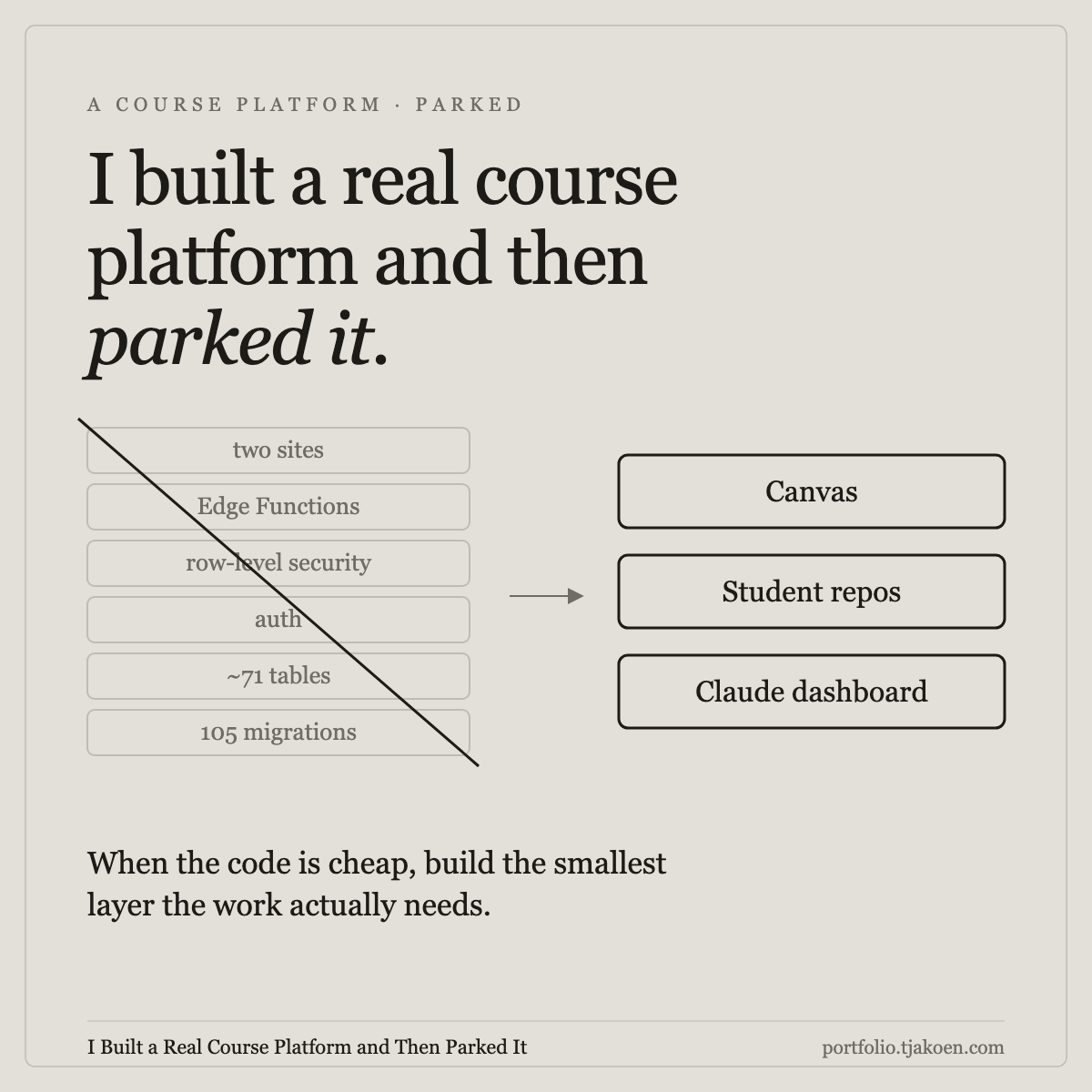
Today I parked a course platform I spent weeks building. It had 105 database migrations, about 71 tables, row-level security on all of them, and two sites deployed on Cloudflare Pages. No student ever logged into it.
That last fact is the whole note, really. But it took me a while to see it, so here is the long way round.
The platform I already had
I teach software-engineering sections at a university. For a while now the course has run on a platform built out of GitHub itself. Each class gets an organization, I keep a teacher repository per section, every student works in their own repository, and grading runs in GitHub Actions. A sync pushes the results to Canvas, which is where the university expects grades to live.
It is not pretty. It is a pile of workflows, scripts and conventions. But it works, the students already live in GitHub for the actual coursework, and it is public at github.com/tjakoen/github-native-course-platform if you want to see what that pile looks like.
The platform I wanted to have
Somewhere along the way I started to feel that the pile was not a real product. A real product has a database. It has accounts and a login page. It has row-level security, so a student can only ever read their own rows. It has functions on a server and a front end on a CDN.
And if I built that, I thought, maybe other teachers could use it. Maybe I could sell it.
So I built it. Supabase for the database, auth and Edge Functions, Cloudflare Pages for two sites. With Claude and Codex doing most of the typing, it went fast, which is exactly the problem. Fast meant I never had to stop and ask whether each table earned its place. As a snapshot on the day I parked it, the build held 105 migrations and about 71 tables.
What it actually did
A few weeks in, I sat down to plan the step where students would finally use it, and I listed what it would do for them on day one.
Submit work: they already do that, in their repositories. See their grade: Canvas already shows it. Get feedback: it already comes back in the repository, from the Actions run. Know whether they were in class: that was the one thing the old setup did not track.
Nearly everything on the list was a copy of something that already worked, moved into tables I now had to keep in step with the originals. I had not built a platform. I had built a second source of truth for data that already had one.
What runs my sections now
The answer turned out to be smaller than either platform.
Canvas and the student repositories are the source of truth. Canvas holds the grades because the university already treats it as the record. The repositories hold the work, because that is where the students already are.
The one gap, attendance, closed itself without a table. Every lab has an in-class activity that the students submit before they leave. If the submission is there, they were there. The work they hand in is the attendance sheet.
And the management side, the part I thought needed a whole admin app, is a dashboard Claude builds and updates when I ask a question about my sections. It reads from the two sources of truth. It owns nothing, so there is nothing in it to drift.
Thinking the old-fashioned way
Here is the line I keep coming back to. I have the modern way of coding: I describe what I want and an agent writes it. And with that in my hands, I was still thinking the old-fashioned way.
The old way says a serious tool needs its own database, its own accounts and its own admin screens, because building those is the expensive part, so you build them once and properly. That rule made sense when the code was the cost. It is not the cost any more. An agent can write 105 migrations faster than I can review them. What still costs something is every place the truth lives, every system that has to agree with another one, and every screen someone has to learn.
So the question changed. It is no longer "what would a real product have?" It is "what is the smallest layer the work actually needs?" For my sections, the answer was a dashboard over two systems that already existed.
The same call, twice
This is not the first time I made this exact decision. At work I wanted a view of my team for one-on-ones, and my first serious answer was People Manager, a whole app I was coding myself. It stalled. Then one afternoon I asked Claude for a dashboard instead, pointed it at the data, and handed it People Manager as a reference. That dashboard became Crew Watch, and I wrote the story up in I Showed My Team a Dashboard.
Both times the shape was the same: a classic app, built because it felt like the grown-up version, replaced by the systems already in use and a dashboard on top of them. You would think I would have recognised it the second time sooner.
How I parked it
Parking is not the same as deleting, so I did it carefully. The repository is archived with a tag at its last state. The database was backed up and then deleted. The paid Supabase plan moved to another project that actually needs a database. And the README and docs of the GitHub-based platform were updated the same day, so they describe how the course really runs now.
If a day comes when other teachers want this, the tag is there. But I would start that day by asking what they already use, not by opening a migration file.
Where it sits now
Today I parked a platform no student ever logged into. The course did not notice. That is the clearest sign I have that it was never the course's platform. It was mine.
The judgment is human. The typing, by design, is not.