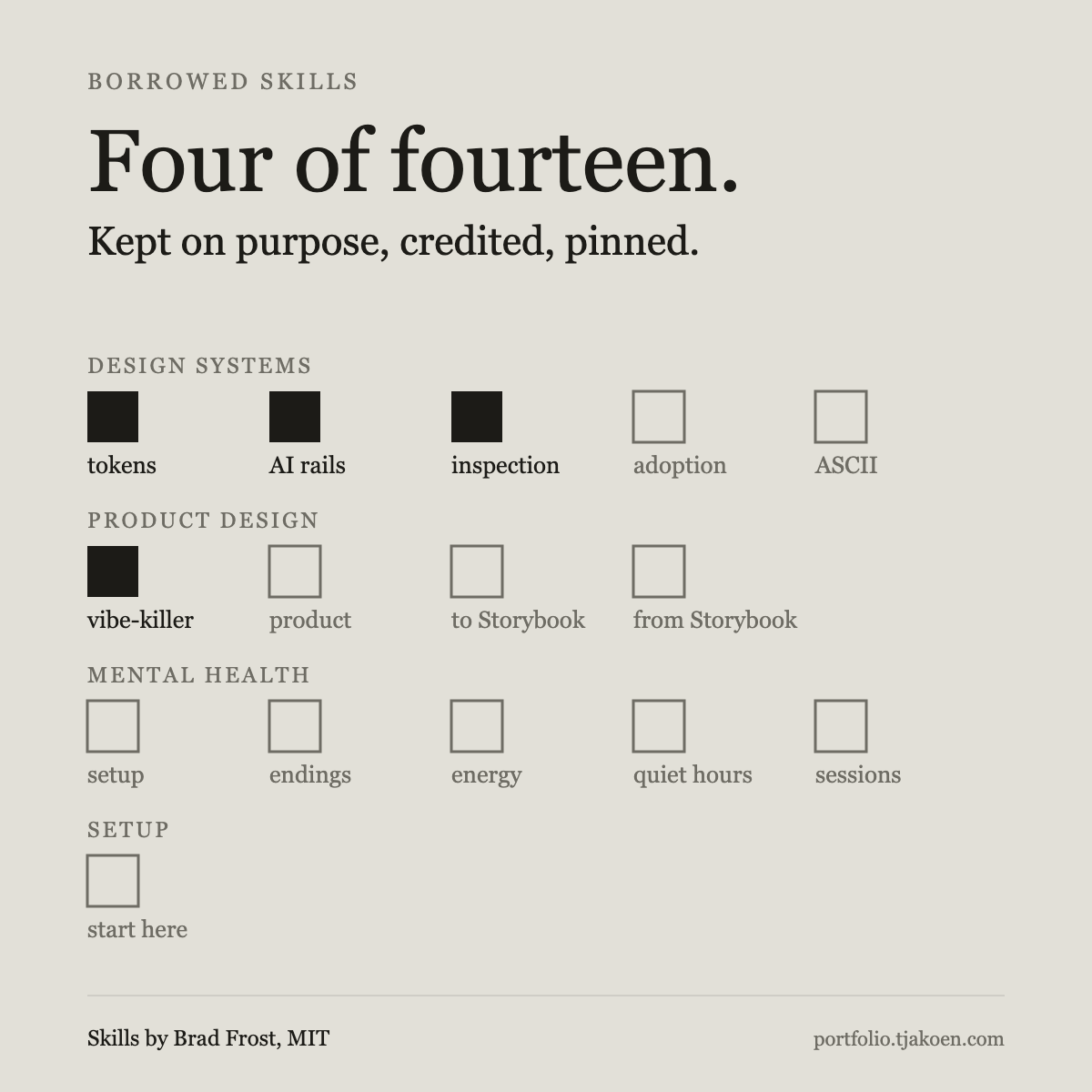
Four of Fourteen: Borrowing Brad Frost's Skills for GRAIN
Someone whose book shaped how I build just published his skills for AI agents. I took four, left ten, and wrote down why for each one.
Fourteen skills on a Saturday
Fourteen skills. Three folders and a setup script. One author whose idea of atoms, molecules and organisms is how I still think about components. [Confirm, or swap in how Atomic Design actually reached you.]
Brad Frost published his skills for AI agents, under MIT, and the timing was rude. A few hours earlier a session of mine had found that GRAIN's muted ink failed contrast on some surfaces, darkened it, and cut a release. A design system that calls itself AI-operable had just been caught by the most boring check in the book. So when a design-systems person I learned from offers to lend me his checklist, I read it.
I did not install all fourteen. That was the whole exercise.
Where borrowed skills live
I keep two shelves. My own skills, the ones I wrote, sit in one folder and get linked into every tool I use. Skills somebody else wrote sit in a separate folder called third-party, as a pinned copy with the licence beside it, so when a review cites one I can point at the exact text it ran against.
That shelf already had two sets on it before today:
- the Dashboard Design plugin by UXKIN, MIT, which I audit PANTRY's pages against;
- Anthropic's Design plugin, from their knowledge-work plugins, which ships without a licence file and is noted that way.
Brad's four went in as the third, at a pinned commit, with his MIT licence at the top of the folder and again inside each skill, because a skill gets copied on its own more often than a folder does.
The four I kept
GRAIN makes four promises it can be held to. Components read tokens, never a hard-coded color. Humans and the AI work through one vocabulary, no back door. The grade on the type is a signal that the machine had a hand in something. And the contrast contracts hold on every surface, which, as of this week, I can no longer say I checked by feel.
Each skill I kept tests one of those from the outside:
- ds-token-architecture checks a token set against a three-tier ladder, from definitions to usage to components. That is the tokens-only rule, examined by a stranger who did not write it.
- ds-ai-rails asks whether a coding agent actually stays on the system or quietly freehands its own CSS. That is the one-vocabulary rule, seen from the agent's chair.
- ds-inspection walks a design system through ten stations, including accessibility, machine-readable docs and agent access. Those last two are where GRAIN's MCP server and its contracts live, and the first is where the muted ink failed.
- vibe-killer takes a page full of bespoke CSS and rebuilds it from real components. MILL pages and these notes drift into one-off styling more often than I'd like to admit, and this is the cleanup I keep doing by hand.
The ten I left, and the reasons
The two Storybook skills move screens between a product and its Storybook, in each direction. GRAIN has no Storybook. Its catalog is a living page the AI can drive, which is sort of the point of it, so these would be solving a problem I deliberately don't have.
The adoption plan and the product inspection are about a product taking on a design system, not the system itself. They will matter the day someone adopts GRAIN in an app I don't own. That day is not today.
The ASCII wireframe skill is charming, and I mean that. It sketches a page as monospace art where every region maps to a real component. I already sketch on paper, which is the one tool in my stack I have never had to upgrade, so it fills no gap.
The last six were the hardest call. The limits skills set quiet hours, a ceiling on sessions per day, and a definite ending to each session, and wire them in through hooks. Honestly, a man who works sixteen-hour days by choice is the target audience. But my sessions already run through a loop with its own hooks and its own rules for how a session ends, and two sets of hooks arguing over whether I'm allowed to open a terminal is a bad way to find out which one wins. If I take them, I'll take them on purpose, as a decision about my own habits, not as a side effect of a design-system review.
A borrowed skill is a second opinion. It becomes a rule the day I write its finding into my own standard.
What I have not done yet
I have not run any of the four against GRAIN. They sit on the shelf, copied and credited, and they are not even loaded into a session yet, because the folder they live in is not wired into my tools. Every reason above is a reading of what each skill says it does, not a measurement of what it found. [Run ds-token-architecture and ds-inspection on GRAIN and record what they caught.]
I also don't know yet whether a three-tier ladder fits a system whose grade tokens carry meaning rather than color. That is exactly the kind of disagreement I want a stranger's checklist to start.
Credit where it's due
Brad Frost wrote the four skills I kept, and the Atomic Design idea GRAIN is built on. The skills repository is MIT, copyright Brad Frost Web LLC. The other two sets on the same shelf belong to UXKIN and to Anthropic. None of them is my work. I just kept the receipts.
A muted ink failed contrast, and the fix was a darker gray. The lesson was cheaper still: check the boring things with somebody else's list.
The judgment is human. The typing, by design, is not.